
Treatments Explained5 min read
Dermapen or RF Microneedling: Key Differences
“If you are excited to understand more about Dermapen or RF Microneedling, please consult our experienced doctors at Kaiteki Clinic. We will create a personalized treatment plan tailored to your needs!
Introduction
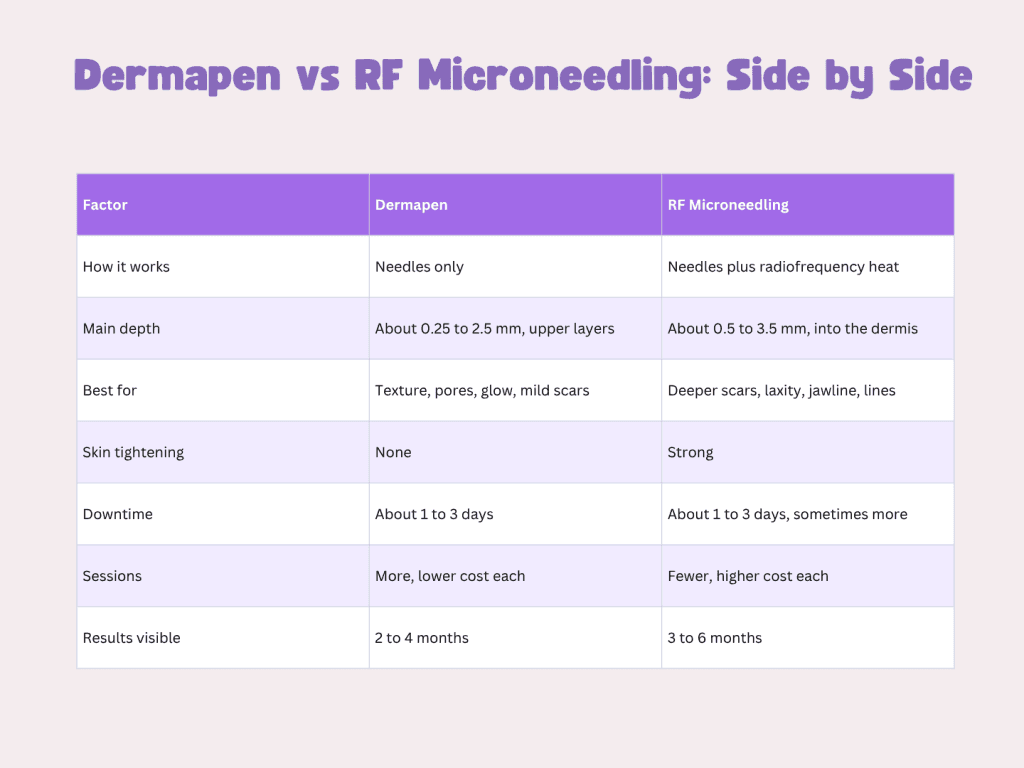
Both treatments use tiny needles to trigger your skin into rebuilding itself, but they are not interchangeable, and choosing the wrong one wastes time and money. The simplest way to think about it: Dermapen works mostly at the surface to refine texture and glow, while RF microneedling adds radiofrequency heat that reaches deeper to tighten skin and treat stubborn scars.
That single difference, heat and depth, decides which one suits your concern, how much downtime you face, and how many sessions you need. This guide explains the real differences, what the evidence actually shows for acne scars, and how to choose based on your skin rather than a sales pitch.
What Is Dermapen Microneedling?
Dermapen is a pen device with very fine needles that create thousands of microscopic channels in the skin, usually at depths from about 0.25 up to 2.5 mm depending on the area and concern. Those controlled micro injuries kick off your natural wound healing response, which ramps up collagen and elastin, the proteins that keep skin smooth and firm.
It works mainly in the epidermis and upper dermis, so it is brilliant for refining texture, softening fine lines, shrinking the look of pores, and improving mild scarring. A useful bonus is that the channels let serums absorb more deeply during the session.
Because it is gentler, recovery is short and the cost per session is lower, though you will typically need more sessions than with radiofrequency.
What Is RF Microneedling?
RF microneedling adds radiofrequency energy to the needling. As the needles reach into the dermis, often anywhere from 0.5 up to 3.5 mm depending on the device and area, they release heat at their tips that creates tiny zones of controlled thermal injury.
That heat tightens existing collagen and triggers a stronger wave of new collagen, without ablating or burning off the surface. The payoff is firmer skin, more lift along areas like the jawline, and better results on deeper acne scars and laxity than needling alone can deliver.
Devices in this category include Potenza, Sylfirm X, Morpheus8, and Secret RF, each tuned slightly differently. We have explained on what Potenza RF microneedling does.
What the Evidence Says for Acne Scars
Here is something most blogs leave out: there is real published data, not just clinic promises. In one clinical study of patients with atrophic acne scars, including darker Fitzpatrick types three to five, four sessions of RF microneedling spaced about six weeks apart led to meaningful improvement, with more than 80 percent of patients improving by at least two grades and every patient showing some improvement.
Just as important is which scars responded. Rolling and boxcar scars, the softer sloping kinds, improved well. Narrow, deep ice pick scars responded poorly and usually need other tools such as subcision or a focused acid technique. So if your scars are mostly rolling or boxcar, RF microneedling is a strong bet.
If they are ice pick, you need a combination plan, and any clinic that ignores that distinction is not giving you the full picture.
Is It Safe for Darker, Asian Skin?
This is a genuine concern for Malaysian skin, where the risk of dark marks after treatment is higher. The good news is that RF microneedling has been used safely on darker skin types, and many modern devices use insulated needles that release the radiofrequency energy only at the tip, deeper down, sparing the melanin rich surface.
That design lowers the risk of post inflammatory hyperpigmentation compared with ablative lasers. Being honest though, the risk is not zero. In the study mentioned above, a small share of patients, roughly one in six, still developed some temporary hyperpigmentation. So the realistic message is that these treatments are generally suited to darker skin when done carefully, with sun protection afterwards, but you should expect your provider to discuss this risk openly rather than wave it away.
Which Skin Concerns Suit Each Treatment?
- Dull or rough texture and small pores: Dermapen is a great fit
- Fine lines and a maintenance glow: Dermapen, or either with guidance
- Sagging or loss of firmness, jawline definition: RF microneedling
- Rolling and boxcar acne scars: RF microneedling responds well
- Ice pick scars: combination plan with subcision or focused acid work
- Sensitive budget but happy with more visits: Dermapen
Downtime, Cost, and Combining Treatments
Both treatments use numbing cream, so they are tolerable rather than painful. Dermapen usually leaves mild redness like a light sunburn for a day or two. RF microneedling reaches deeper, so redness, slight swelling, and warmth can last a touch longer, though most people are back to normal activity the next day.
On cost, RF microneedling in Malaysia commonly runs from around RM1,500 to RM3,200 per session and needs roughly three to five sessions, while Dermapen is noticeably cheaper per visit but needs more of them. The smart way to compare is cost per result, not per session.
For deeper scars, the strongest plans often combine RF microneedling with subcision or platelet rich plasma, and a hydrating booster can extend the glow afterwards, which our overview of skin booster treatments explains.
Conclusion
Dermapen and RF microneedling both rebuild collagen, but they solve different problems. Dermapen is the gentle, affordable choice for texture, pores, and glow. RF microneedling brings heat and depth for firmer skin and deeper scars, with published evidence behind it for rolling and boxcar acne scarring.
Match the tool to your concern, factor in your skin tone and budget, and treat ice pick scars as a special case. If you are starting to notice changes and want to act early, our piece on early signs of ageing is a good next read.
And if you would like help choosing, our team can assess your skin and point you the right way.
Contact us to find out if you’re a suitable candidate for Dermapen or RF Microneedling and we will plan out a customised treatment for you.
Book a free consultation
A doctor will assess your skin and tell you honestly whether this is the right option for you, including when it is not.
About the author

Dr Chew Yuhhui
Co-Founder & Senior Medical Director
MBBS, LCP Board Certified, MAC, MSAM · MMC 68232
Allow your passion to become your purpose and it will one day become your profession.
View full profile- Written by
- Dr Chew Yuhhui, MMC 68232
- Published
- 24 May 2026
- Topics
- Microneedling
This page is general information about aesthetic treatments and is not medical advice. Treatments carry risks that are explained during consultation, and individual results vary. A doctor will assess whether a treatment is suitable for you before it is carried out.