Device & Injectables6 min read
Plenhyage vs Rejuran: Key Differences, Benefits, and Results
“If you are excited to understand more about Plenhyage vs Rejuran, please consult our experienced doctors at Kaiteki Clinic. We will create a personalized treatment plan tailored to your needs!
Introduction
Here is the honest short answer before we get into detail. Plenhyage and Rejuran are both polynucleotide skin boosters made from purified salmon DNA, and they do broadly the same job: calm the skin, boost hydration, and nudge your body to rebuild collagen.
Rejuran is the Korean original with the longest track record. Plenhyage is a newer Italian option that clinics often market as stronger or more concentrated. That marketing line is where most of the confusion starts, so this guide separates what is genuinely proven from what is sales talk, and helps you decide based on your skin and your budget rather than the hype.
What Is Rejuran?
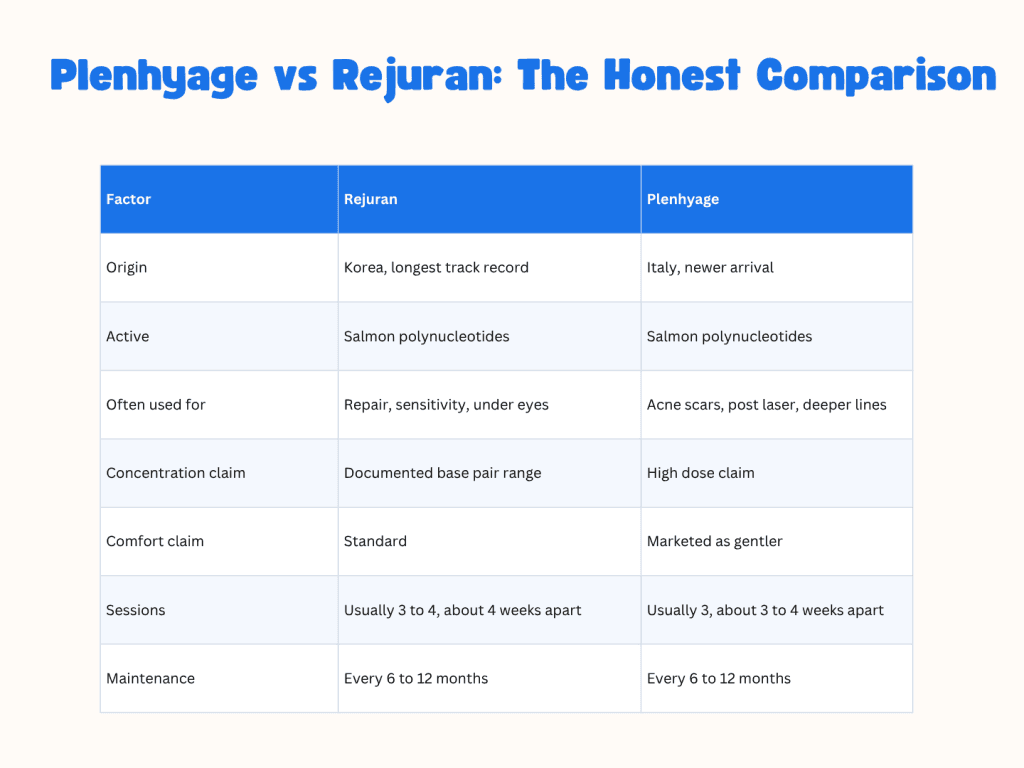
Rejuran is built around polynucleotides, which are healing fragments of DNA taken from salmon. Those fragments, roughly 50 to 300 base pairs long, act like a repair signal once they are injected into the upper layers of your skin. They calm inflammation, improve hydration, and gradually stimulate collagen, the protein that keeps your skin firm and bouncy.
Because it is gentle and soothing, Rejuran is a favourite for sensitive or reactive skin, dull texture, and tired looking under eyes, where a dedicated version is used for that thin, delicate area. It has been on the market the longest of the polynucleotide boosters, so providers have years of real world experience with it. If you want the bigger picture first, our overview of skin booster treatments sets the scene well.
What Is Plenhyage?
Plenhyage is also a salmon derived polynucleotide booster, so it sits in exactly the same family as Rejuran. It comes from Italy and is usually offered in two strengths, a medium version and a stronger XL version. The stronger version is often positioned for more intensive concerns such as acne scarring, post laser recovery, and deeper lines.
You will frequently see clinics quote a high polynucleotide dose per session, sometimes around 50mg, and describe Plenhyage as more comfortable to inject. It is worth being clear eyed here: those figures and comfort claims come from suppliers and clinics rather than independent published trials, so treat them as marketing positioning, not settled fact. The underlying science is the same proven polynucleotide repair mechanism that Rejuran uses.
Plenhyage vs Rejuran: The Honest Comparison
Because both share the same active ingredient, the real differences are about track record, positioning, and which concern you are treating. Neither is a filler, so do not expect either to add volume or reshape your face. The table below keeps it straight, including where a claim is evidence based and where it is mostly marketing.
Marketing vs What Is Actually Proven
This is the part most blogs skip. The strongest, best documented product of the two is Rejuran, simply because it has been studied and used for longer. However, there is no real best product in the market. Each product has its own merits.
A higher dose on paper does not automatically mean a better result on your face, and more product is not always better for delicate areas. Likewise, the claim that one stings less than the other is highly dependent on technique, numbing, and the injector’s skill.
None of this means Plenhyage is bad. It is a genuinely good booster. It just means you should weigh the actual evidence rather than the brochure, and trust an experienced injector over a marketing line
Which One Should You Choose?
Match the booster to your main concern. If your skin is sensitive, reactive, or you mainly want to refresh dull texture and tired under eyes, Rejuran and its long track record are a safe, well understood choice. If your focus is acne scarring, recovery after laser, or deeper lines and you want a more intensive option, the stronger Plenhyage version is reasonable to consider.
Budget matters too, since a full course is several sessions. Be honest with yourself about what you are treating and how much you want to spend across the whole plan rather than per visit, because that is what really shapes value.
Can You Combine Plenhyage and Rejuran?
Yes, and many clinics do exactly this. A common approach is to use Rejuran first to calm and repair the skin, then bring in a firming focused booster once the skin is in better condition. Polynucleotides also pair well with other regenerative injectables in a longer plan.
If you are mapping out a wider routine, it helps to know your options, so our guides to the Juvelook skin booster and the Deusaderm collagen boosting injectable are useful companions. The key is sequencing and spacing, which a provider will plan around your skin rather than treating everything at once.
What Results and Downtime Really Look Like
Set realistic expectations, because these are gradual treatments, not instant fixes. On the day, expect tiny bumps where the product was placed, plus some redness or mild swelling. For the first one to three days those bumps settle and any redness fades.
Around week four, after a session or two, most people start to notice skin that looks fresher and feels more hydrated and bouncy. The fullest effect tends to land around the three month mark once collagen has had time to rebuild. Results are not permanent.
Most people maintain them with a top up every six to twelve months. Keep the skin clean and moisturised afterwards, skip heavy makeup for a day, avoid saunas and intense workouts briefly, and wear sunscreen.
How Much Do They Cost in Malaysia?
Prices vary a lot by clinic, area treated, and the version used, so treat these as rough guides and always confirm with your clinic. In Malaysia, a single Rejuran session commonly falls somewhere in the region of RM800 to RM1,800, with full course packages of three sessions often bundled at a saving.
Plenhyage tends to sit in a broadly similar range, with under eye work usually costing less than full face. Because both treatments need a course rather than one visit, look at the total cost of the plan, not just the headline per session price. A package with a few maintenance sessions built in is often better value than paying piecemeal.
What to Ask Before You Book
- Which exact product and strength are you using, and why that one for my skin?
- How many sessions do I realistically need, and how far apart?
- Is the dose or comfort claim based on evidence or supplier information?
- What does the full course cost, including any maintenance?
- Who is performing the injections and what is their experience?
Conclusion
Plenhyage and Rejuran are two strong versions of the same good idea: salmon polynucleotides that repair, hydrate, and refresh your skin over time. Rejuran wins on track record and is the safer pick for sensitive skin and under eyes, while the stronger Plenhyage is a fair choice for scarring and deeper concerns, as long as you read its bigger claims with a healthy dose of scepticism.
The smartest move is to match the treatment to your skin and your budget, guided by an experienced injector. If you would like help deciding which one fits, our team is happy to walk you through it.
Contact us to find out if you’re a suitable candidate for Dermapen or RF Microneedling and we will plan out a customised treatment for you.
Book a free consultation
A doctor will assess your skin and tell you honestly whether this is the right option for you, including when it is not.
About the author
Dr Jessie Lim Jia Min
Founder & CEO, Aesthetic Physician
MD, LCP Board Certified, MAC, AAAM · MMC 64964
Dr Jessie Lim is a LCP certified aesthetic doctor. She obtained her medical degree from University Putra Malaysia with honours. She then went on to pursue her post-graduate certification in Aesthetics in Medical Aesthetic Certification Programme and American Academy of Aesthetic Medicine (AAAM).
View full profile- Written by
- Dr Jessie Lim Jia Min, MMC 64964
- Published
- 25 May 2026
- Topics
- Rejuran
- Last reviewed
- 26 May 2026
This page is general information about aesthetic treatments and is not medical advice. Treatments carry risks that are explained during consultation, and individual results vary. A doctor will assess whether a treatment is suitable for you before it is carried out.