Device & Injectables7 min read
Radiofrequency skin tightening: how it works and what it treats

Radiofrequency skin tightening uses controlled electrical energy to warm the deeper layers of the skin, prompting collagen to contract and then remodel over the following months. It is non-surgical with little downtime, suited to mild to moderate laxity rather than marked sagging, and usually planned as a short course of sessions.
Radiofrequency skin tightening uses controlled electrical energy to warm the deeper layers of the skin. The heat makes existing collagen contract, then sets off a slow repair response in which new collagen is laid down over the following months. Nothing is cut and the surface is not wounded, which is why most people go back to their day straight afterwards.
This guide covers how it works, the different kinds of device, what it can and cannot do, what a session and the weeks after it look like, and who it suits. It is written to help you arrive at a consultation knowing what to ask, not to decide the answer for you.
Key takeaways
- How it works: heat in the dermis makes collagen contract, then prompts new collagen to form over weeks to months.
- Not one device: surface RF warms a broad area; RF microneedling delivers heat through fine needles at set depths. They suit different concerns.
- Best for: mild to moderate laxity and early loss of definition. It is not a substitute for surgery where there is significant excess skin.
- What a course looks like: commonly two to three sessions, four to six weeks apart, then maintenance.
- How long it lasts: results typically last one to two years, depending on age, skin quality, sun exposure and lifestyle.
- Downtime: surface RF usually means a few hours of redness. RF microneedling needs a little longer.
How does radiofrequency skin tightening work?
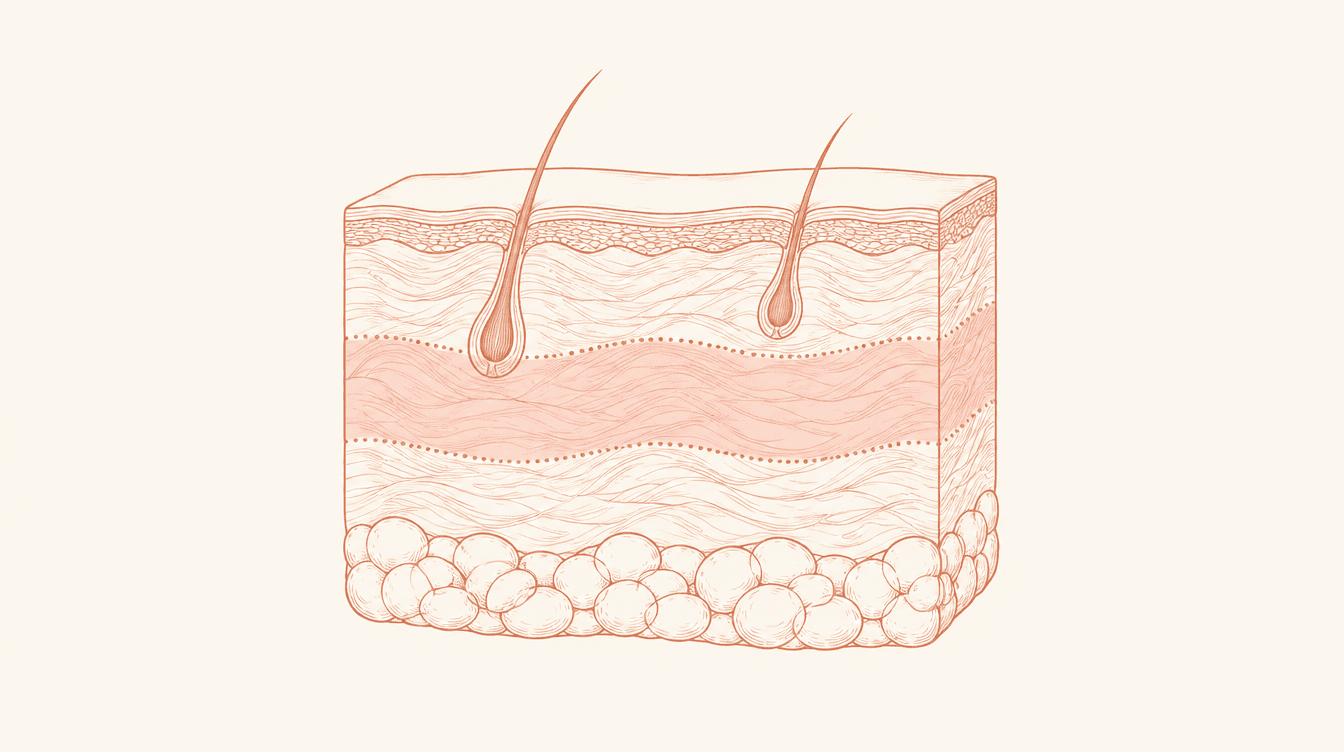
Radiofrequency is an electrical current that alternates millions of times a second. As it passes through tissue, the tissue's resistance turns it into heat. Unlike most lasers, it does not depend on pigment to absorb the energy, which is part of why it is used across a wide range of skin tones.
The heat does two things. Straight away, collagen fibres in the dermis contract slightly. Over the following weeks, the warmed tissue goes through a repair response in which fibroblasts lay down new collagen. A study in the Journal of the American Academy of Dermatology found a measurable increase in dermal collagen on skin biopsies three months after monopolar RF treatment. That slow second phase is why results build gradually rather than appearing on the day.
The main types of radiofrequency device
Radiofrequency devices differ mainly in how the energy travels and how deep it goes. That decides what each is used for.
| Type | How the energy travels | Commonly used for | At Kaiteki |
|---|---|---|---|
| Monopolar | From one handpiece to a return pad, reaching deeper tissue | Facial firmness, body contour | XERF, BTL Exilis, Oligio |
| Bipolar | Between two points on the same handpiece, more contained and shallower | Facial firmness, often combined with other modes | Wonderface |
| RF microneedling | Through fine needles, released at set depths inside the skin | Texture, acne scarring, pores, firmness | Morpheus8, Potenza, Sylfirm X |
Surface devices use cooling to protect the skin while the heat builds underneath. Microneedling devices put the energy exactly where the needle tip sits, which lets the doctor work on texture and scarring as well as firmness, at the cost of a little more downtime. Our radiofrequency treatment and microneedling pages describe each in more detail.
What does radiofrequency treat?
Radiofrequency is commonly considered for:
- loss of firmness along the jawline and lower face
- early jowling and a softening contour
- crepey skin, including the lower eyelid
- fine lines and uneven texture
- acne scarring and enlarged pores, mainly with RF microneedling
- areas of the body where the skin has lost firmness, assessed individually

What it does not do is lift marked sagging or remove loose skin. If the laxity is significant, for example after large weight loss, surgery or a combined plan is usually the more honest answer. Our face lifting page sets out the wider range of options.
What happens during a session?
First visit
Consultation
A doctor assesses your skin and laxity. No treatment on the first visit.
30 to 60 min
Session
Energy delivered in passes with cooling. A deep, building warmth.
Same day
Recovery
Mild redness or warmth that usually settles within hours.
4 to 6 weeks
Next session
A course of about two to three sessions is common.
Months after
Gradual change
Collagen remodels slowly, so change builds over months.
On the day, the skin is cleansed and, for surface devices, a conductive gel or coupling is applied. The doctor moves the handpiece across the area in passes. Most people describe a warmth that builds and eases as the handpiece moves, rather than pain. For RF microneedling, numbing cream is usually applied first, because the needles go into the skin.
Afterwards there is usually nothing dramatic to see. Mild redness typically settles within a few hours, and makeup can generally be worn after a facial session. With RF microneedling, expect redness and small marks for a few days.
How long do results last?
Results typically last one to two years, though this varies with age, skin quality, sun exposure and lifestyle. Because the change comes from new collagen, it fades gradually rather than all at once. Maintenance sessions help it hold, which is why they are usually part of the plan rather than an afterthought.
Sun protection matters here too. UV breaks down collagen, so daily SPF protects what the treatment builds.
Who is a good candidate?
Radiofrequency tends to suit people who have:
- mild to moderate loss of firmness on the face, neck or body
- early jowling or a softening jawline
- crepey texture or fine lines they want to improve gradually
- a preference for little downtime over surgery
- realistic expectations of a gradual, modest change
It is deferred during pregnancy, and avoided with a pacemaker or other implanted electronic or metal device in or near the area, over active infection or inflamed skin, and with a history of keloid scarring. Tell your doctor about retinoids or recent peels, because both change what the skin will tolerate on the day.
Risks to understand
Redness, warmth and mild swelling are common and usually settle within hours to a day. The effects that matter are burns and lasting pigment change, and both trace back to energy settings that were wrong for the skin. That is why the device and settings are chosen by a doctor for your skin, not fixed at the machine.
Radiofrequency, HIFU and other lifting options
Radiofrequency is one of several energy-based ways to prompt collagen. HIFU uses focused ultrasound delivered to set points at depth, including the support layer beneath the skin, and is often considered where lift rather than surface firmness is the goal. Laser-based options such as Alma Titanium Lifting work on several layers at once. If you are weighing up the ultrasound options, Ultherapy vs HIFU explains how they differ.
None of these is the best device in the abstract. The right one depends on how much laxity there is, where it sits and how your skin behaves, which is a question for the consultation.
Aftercare
- Use broad-spectrum sunscreen daily, because UV breaks down collagen
- Avoid saunas, hot yoga and very hot showers for about 24 hours
- Keep to gentle skincare for a few days, and pause retinoids if your doctor advises it
- After RF microneedling, follow the specific wound-care advice you are given
- Keep the follow-up sessions in your plan, since the course is what builds the change
Common questions
Is radiofrequency the same as HIFU?
No. Both prompt a collagen response, but HIFU uses focused ultrasound delivered to set points at depth, while radiofrequency warms a broader volume of tissue. They suit different degrees of laxity, which is why clinics often offer both.
How many sessions will I need?
A course of about two to three sessions, roughly four to six weeks apart, is common, followed by maintenance. The plan is set after assessment rather than fixed in advance.
Does radiofrequency hurt?
Most people describe a deep, building warmth, like a hot stone massage, rather than pain. Surface devices use contact cooling. RF microneedling is different: numbing cream is usually applied first.
How long do the results last?
Results typically last one to two years, depending on age, skin quality, sun exposure and lifestyle. The change comes from new collagen, so it fades gradually, and maintenance sessions help it hold.
Is it safe for Asian skin?
Radiofrequency heats tissue rather than targeting pigment, so it does not depend on colour contrast and is used across a wide range of skin tones. Settings still matter: burns and pigment change trace back to energy that was wrong for the skin.
Book a free consultation
A doctor will assess your skin and tell you honestly whether this is the right option for you, including when it is not.
Related pages on our site
About the author

Dr Chew Yuhhui
Co-Founder & Senior Medical Director
MBBS, LCP Board Certified, MAC, MSAM · MMC 68232
Allow your passion to become your purpose and it will one day become your profession.
View full profile- Written by
- Dr Chew Yuhhui, MMC 68232
- Reviewed by
- Dr Chloe Wan Poh Yee, MMC 104547
- Published
- 11 October 2026
This page is general information about aesthetic treatments and is not medical advice. Treatments carry risks that are explained during consultation, and individual results vary. A doctor will assess whether a treatment is suitable for you before it is carried out.