

Concern · Hair & Body
Hair Loss
Thinning, receding and patchy hair loss each have different causes.
Free, about 20–30 minutes, no obligation to book treatment.
- Shedding is normal
- Losing some hair daily is part of the growth cycle, not a sign of hair loss.
- Cause before treatment
- Hereditary thinning, a scalp condition and a medical cause are managed differently.
- Timing matters
- Follicles that have been dormant for years respond differently from ones that have not.
On this page
In brief
Hair loss is a change from your usual pattern: gradual hereditary thinning, sudden shedding after illness, childbirth or stress, patchy loss, or loss caused by a scalp or medical condition such as thyroid disease or low iron.
Results from Kaiteki patients
5 photos · tap one to enlarge
Scalp coverage, before and after a course of treatment at Kaiteki
Scalp coverage, before and after a course of treatment at Kaiteki
Scalp coverage, before and after a course of treatment at Kaiteki
Hair density, before and after a course of treatment at Kaiteki
Hair density, before and after a course of treatment at Kaiteki
Photographs of Kaiteki patients, published with consent. Individual results vary and are not guaranteed. These images are not a promise of outcome. A doctor will assess whether any treatment is suitable for you.
What counts as hair loss?
Each follicle moves through a repeating cycle: an active growing phase lasting years, a short transitional phase, and a resting phase after which the hair sheds and the follicle can begin again. Hair loss becomes a concern when the balance shifts, and the reason it has shifted matters more than the shedding itself.
Common causes
Usually more than one of these at once:
- Genetics and family history: hereditary pattern loss is by a wide margin the most common cause in both men and women.
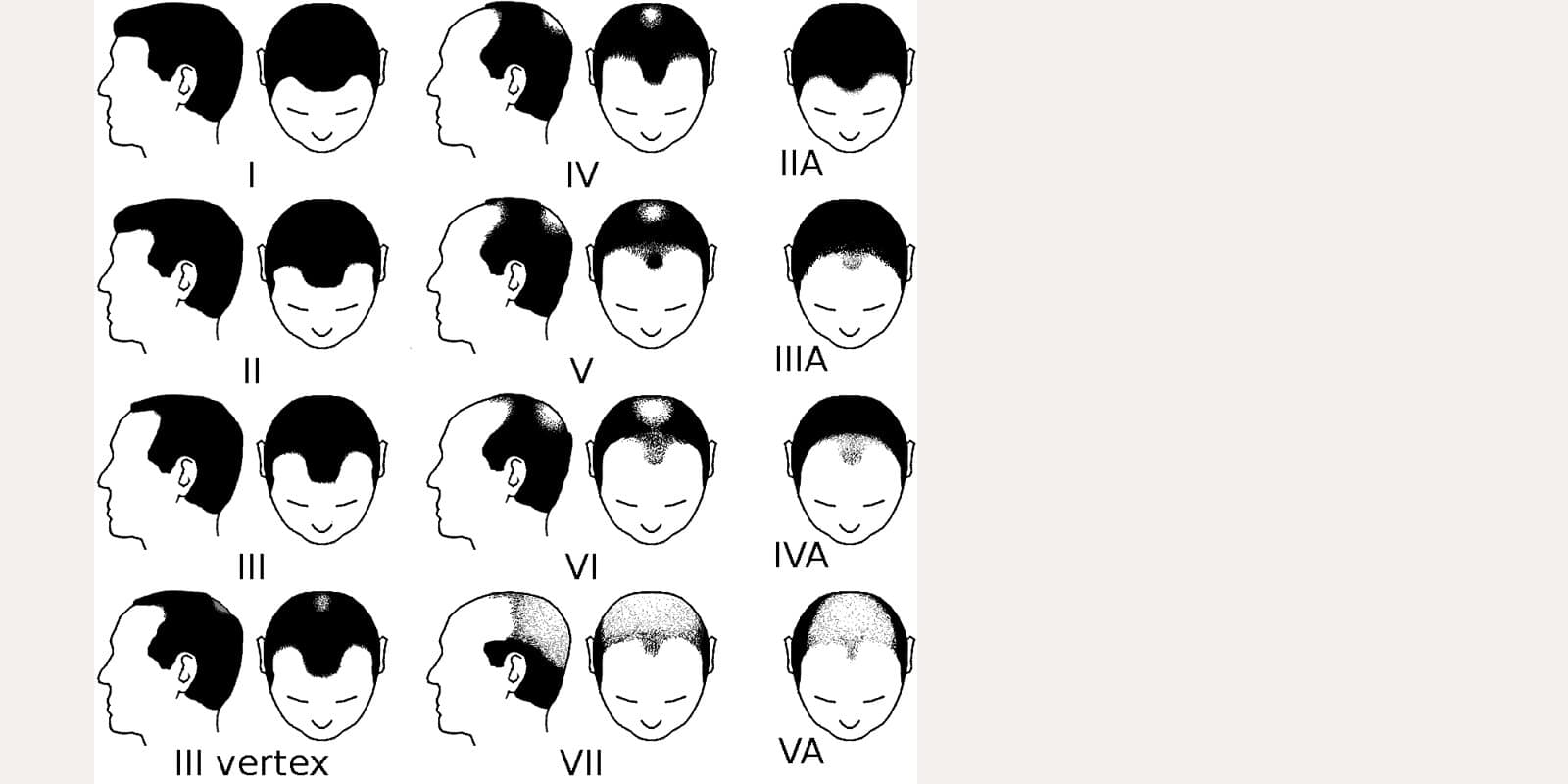
Genetic hair loss in men usually follows a recognisable pattern from the temples and crown, charted here on the Norwood scale. - Hormonal change: childbirth, stopping hormonal contraception, menopause and thyroid disorders all affect the growth cycle, and the loss is frequently temporary.
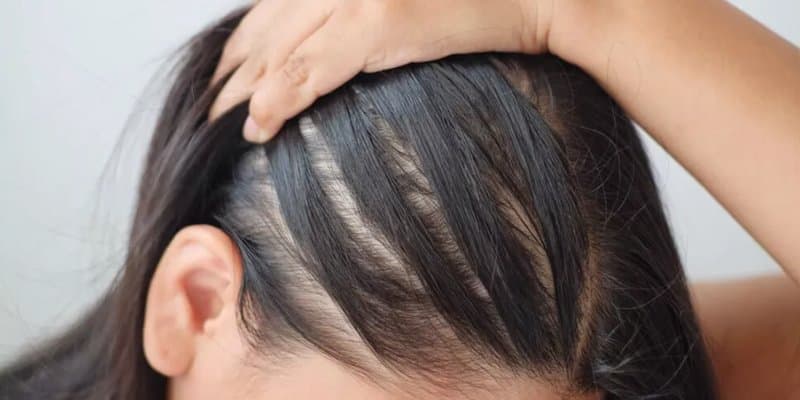
In women, hormonal and genetic hair loss more often shows as a widening parting than as bald patches. - Physical or emotional stress: surgery, serious illness, rapid weight loss or a period of severe stress can push a large number of follicles into the resting phase at once.
- Scalp conditions: fungal infection, seborrhoeic dermatitis and psoriasis inflame the scalp and disrupt the follicles in it.
- Underlying medical conditions: thyroid disease, iron deficiency, autoimmune conditions and some chronic illnesses all show up in the hair.
- Nutrition and medication: restrictive dieting, low iron or protein, and certain medications can all contribute.
- Traction and styling: consistently tight braids, ponytails or extensions pull on the follicle over years. Caught early this is reversible; left long enough, the follicle scars and it is not.
Which kind is it?
The most useful thing an assessment does here is separate hair loss that is the condition from hair loss that is a symptom of something else.
Hereditary pattern loss
Gradual, in a recognisable shape
Gradual thinning in a predictable distribution: a receding temple line and crown in men, a widening central parting with the front hairline preserved in women. It develops over years, without inflammation, itching or a sudden increase in shedding.
- The tell: hairs become finer and shorter over time rather than falling out in numbers, and the pattern is familiar from relatives.
Usually assessed for: assessed for long-term medical management, with supportive in-clinic treatment discussed alongside it.
Hair loss as a symptom
Sudden, patchy or with symptoms
Loss that came on suddenly, appears in discrete patches, follows an illness or a hormonal event, or comes with an itchy, scaly, sore or scarred scalp. Here the hair is a signal.
Usually assessed for: assessed with examination and, where indicated, blood tests, before any cosmetic treatment is discussed.
Pattern on the scalp
Temples and receding hairline
A hairline moving back at the corners is the classic early male pattern. In women a receding frontal hairline is less typical and is worth assessing, as it points toward other causes.Widening central parting
The most common female pattern: the parting broadens while the front hairline stays intact.Discrete round patches
Smooth, well-defined bald patches appearing over weeks: a different condition from pattern loss, needing medical assessment.Diffuse across the whole scalp
Even thinning everywhere, often with noticeably increased shedding, more commonly reflects a systemic cause: a hormonal event, illness, nutritional deficiency or medication.Scarring, redness or soreness?
A scalp that is red, scaly, itchy, painful or shiny and smooth where hair has gone should be examined promptly. Some scarring conditions destroy follicles permanently, and early treatment is what limits it.
When to see a doctor
Some shedding is normal, so the question is what makes it worth an appointment. Any of these is a reason:
- Hair loss came on suddenly, or shedding increased noticeably over a few weeks.
- It followed childbirth, illness, surgery, rapid weight loss or a change in medication.
- You are also noticing fatigue, weight change, or changes to your nails or skin.
Treatment options at Kaiteki
Hair loss is managed medically first. What we offer in-clinic sits alongside that rather than replacing it, and whether it is appropriate depends entirely on what the assessment finds.
Exosome Therapy
For supporting the scalp alongside medical treatment
A regenerative preparation applied to the scalp to support the follicular environment. The evidence base is still developing, and it is offered as an adjunct to medical management rather than as a treatment for hair loss in its own right.
Exosome Therapy
Not sure what kind of hair loss you have?
Send us a photo on WhatsApp and a doctor can tell you which needs looking at first.
Ask about this on WhatsAppFree consultation, about 20 to 30 minutes, no obligation.
Risks and what to expect
Common and usually temporary
Scalp tenderness, redness, mild swelling and itching after in-clinic treatment, usually settling within a few days. Some people notice a brief increase in shedding early in a course, which your doctor should warn you about in advance.The evidence base is still developing
Regenerative treatments for hair are an active area of research rather than settled practice.Treating the wrong thing
The most consequential risk on this page is not a side effect. It is spending months on cosmetic treatment while a thyroid disorder, an iron deficiency or a scarring scalp condition goes undiagnosed.What treatment cannot do
No treatment restores a follicle that has already scarred or been dormant for years, and nothing here changes the hereditary tendency behind pattern loss. Improvement is generally slow, measured over many months, and it is maintained rather than permanent.
Tell your doctor if you are pregnant, breastfeeding or planning pregnancy, take blood thinners, have an autoimmune condition or thyroid disorder, take any regular medication or supplements, or have had a scalp condition, scalp surgery or a hair transplant.
What your first visit involves
The scalp is examined as well as the hair, and blood tests are often part of it.
History
When it started, family history, recent illness, childbirth or new medication, and how you style your hair.
Examination
The pattern, the calibre of the hairs and the scalp beneath, sometimes under magnification.
Investigation where indicated
Blood tests for thyroid function and iron, particularly with diffuse or sudden loss.
Discussion and plan
The likely cause, and where in-clinic treatment fits alongside medical management.
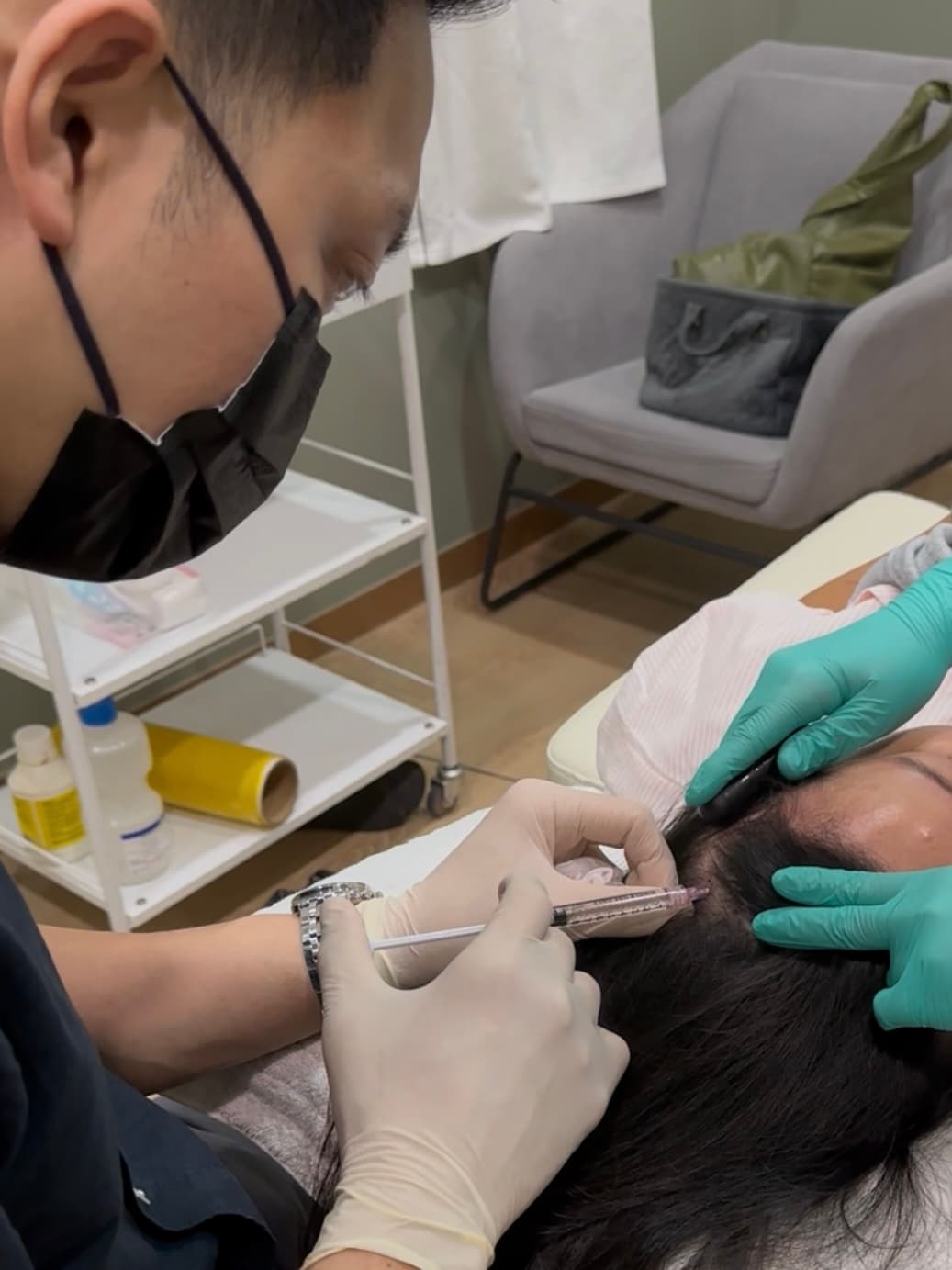
Scalp treatment is carried out along partings, so the doctor can see the skin directly.
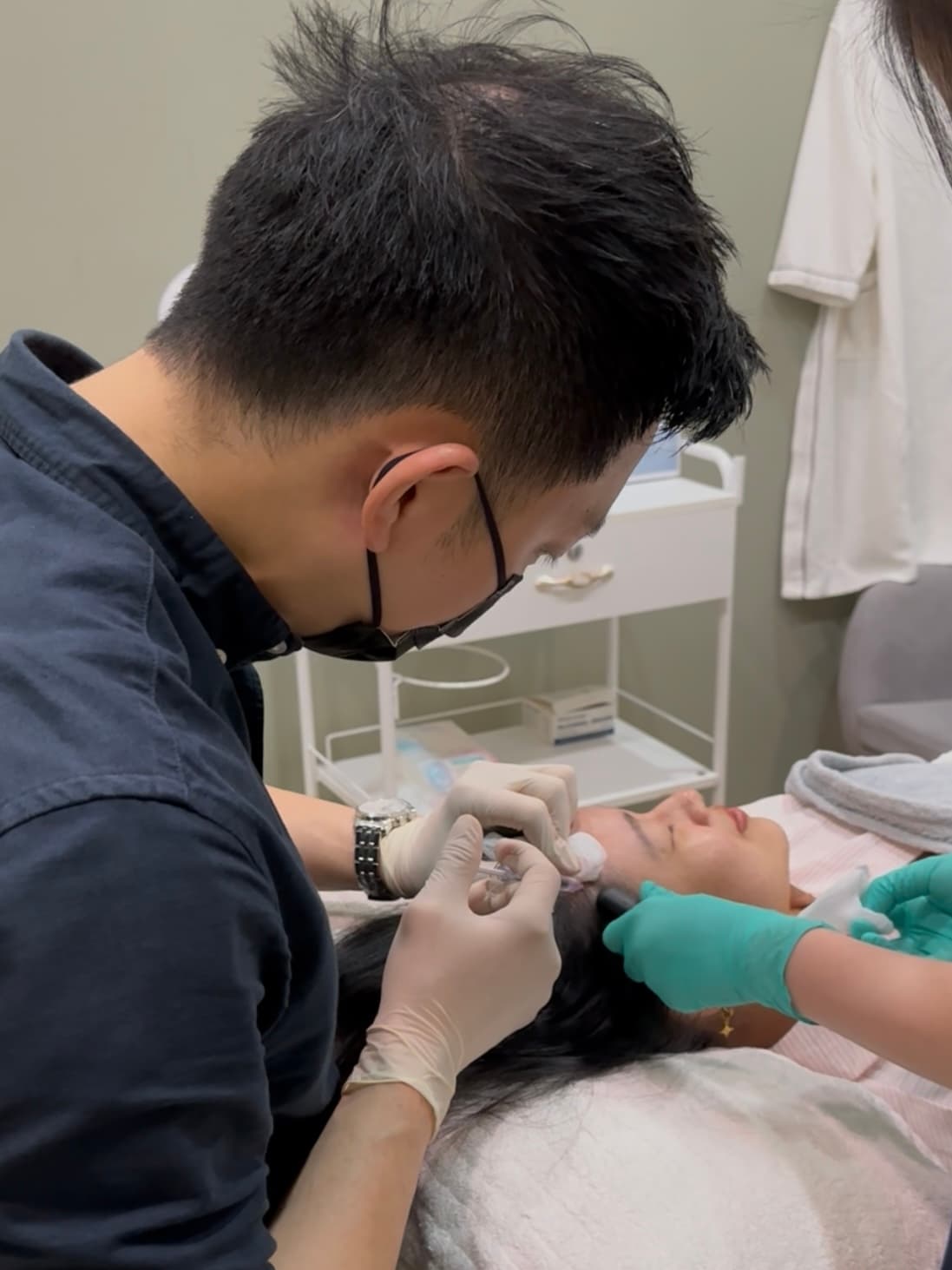
Injections into the scalp are given by the doctor, with the areas planned at the consultation.
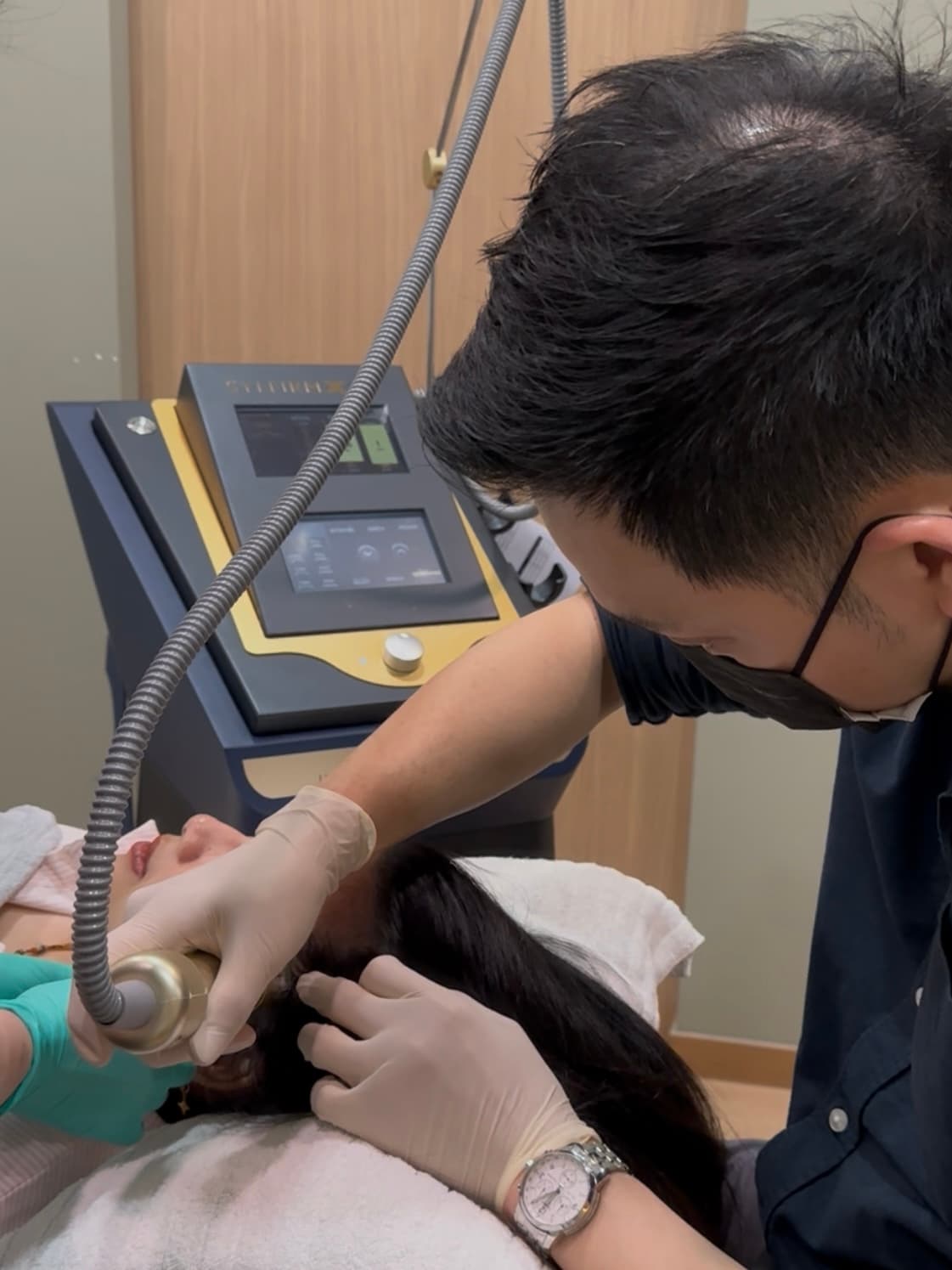
Some scalp treatments use a device rather than a needle.
What affects the cost
Pricing is set after assessment. It depends on:
- Whether investigation such as blood testing is needed before anything is planned.
- The area being treated, since a receding hairline and a diffusely thinning scalp are different in scale.
- How many sessions, which is set after assessment and reviewed as the scalp responds.
- Whether ongoing medical management forms part of the plan alongside in-clinic treatment.
Common questions
How much hair loss is normal?
What matters is change: more shedding than is usual for you, sustained over weeks, or a parting or hairline that looks different from photographs a year or two ago.
Is hair loss treatable?
It depends entirely on the cause. Loss driven by a thyroid disorder, iron deficiency, a scalp infection or a stressful event often improves once that cause is addressed. Hereditary pattern loss is managed long-term rather than cured.
Is hair loss after childbirth permanent?
Usually not. A large increase in shedding a few months after giving birth is a well-recognised pattern caused by many follicles entering the resting phase together as hormone levels change, and for most people it settles over the following months without treatment.
Do supplements help?
Only where you are genuinely deficient, in which case correcting the deficiency can make a real difference. Taking hair supplements without knowing your levels is guesswork, and it is not risk-free: excess of some nutrients, selenium and vitamin A among them, causes shedding in its own right.
Does stress cause hair loss?
It can, through a mechanism where a physical or emotional shock pushes many follicles into the resting phase at once. The shedding typically appears two to three months after the event, which is long enough afterwards that people often do not connect the two.
Can women have hair loss too?
Yes, and it is far more common than the way it is usually discussed suggests. Hormonal events, iron status and thyroid function are all frequent contributors and are routinely checked.
Read next
Related concerns
Excessive Sweating
Scalp conditions and sweating are sometimes assessed together.Aging
Hair thinning is one of the changes people notice alongside skin change.Acne
Scalp inflammation and folliculitis are assessed the same way as facial acne.
Not sure what’s behind your hair loss?
The consultation is free, takes about 20 to 30 minutes, and there is no obligation to book treatment afterwards. A doctor will examine your scalp and talk you through what is, and is not, worth doing.
Book a free consultationMedically reviewed by

Dr Tim Chua
Aesthetic Physician
MBBS, MAC, LCP Certified · MMC 77677
Dr Tim Chua graduated from Taylor's University with an MBBS. Years of working experience as a medical officer in otorhinolaryngology has equipped him with the relevant skills to deal with both medical and surgical cases.
View full profile- Reviewed by
- Dr Tim Chua, MMC 77677
- Last reviewed
- 6 Jun 2026
- Next review due
- 6 Jun 2027