
Injectables
Radiesse
A calcium hydroxylapatite (CaHA) injectable used within bio-stimulator treatment with collagen-supporting properties.
Free consultation, no obligation.
- Calcium hydroxylapatite
- Material
- Merz Aesthetics
- Manufacturer
- Bio-stimulator
- Used within
In brief
Radiesse is an injectable from Merz Aesthetics whose active material is calcium hydroxylapatite in microsphere form, suspended in a gel carrier. It belongs to the bio-stimulator category rather than the hyaluronic acid filler category, which is the distinction that matters when comparing the two.
What is Radiesse?
Radiesse is an injectable made by Merz Aesthetics. Its active material is calcium hydroxylapatite (CaHA) in the form of microspheres suspended in a gel carrier; the manufacturer describes CaHA as a mineral-like substance also found naturally in the body. It belongs to the bio-stimulator category rather than the hyaluronic acid filler category, and Kaiteki uses it within its bio-stimulator treatment.
How calcium hydroxylapatite works
Once placed, the gel carrier provides support immediately and is then absorbed, leaving the CaHA microspheres in the tissue. Those microspheres act as a stimulus around which the body forms its own collagen, and the manufacturer also describes an elastin response. The CaHA itself is bioresorbable (it is broken down into calcium and phosphate components and cleared over time), so what remains later is your own tissue response rather than the injected material.
The manufacturer also describes a diluted application in which Radiesse is thinned with sterile saline so it can be spread across a broader area rather than used for focal support; this is the approach usually referred to as hyperdilute or HD Radiesse, and the manufacturer's own labelling covers a diluted preparation for the décolletage. Whether standard or diluted preparation is appropriate, at what dilution, where and in what quantity are all decisions for the treating doctor after examining you. Kaiteki does not publish dilution ratios, volumes or injection technique, because those are not choices a reader should make. Results develop gradually and vary between individuals.
Filler or collagen stimulator: where does Radiesse sit?
The buyer's distinction is what happens on the day versus what happens later. A hyaluronic acid filler adds volume immediately and can be dissolved if needed; a pure collagen stimulator such as a poly-L-lactic acid product works mainly over months. Radiesse sits between the two in behaviour: the manufacturer describes immediate volume correction from the gel carrier alongside stimulation of the skin's own collagen and elastin over time, with the CaHA microspheres being gradually resorbed. Whether that profile suits your concern is a clinical judgement your doctor makes at an in-person consultation.
Unlike hyaluronic acid fillers, it has no dissolving agent, so it cannot be reversed on demand. The calcium hydroxylapatite is bioresorbable and is cleared by the body over time, and your own tissue continues to age, so duration varies between individuals and is not something we quote as a promise.
Can Radiesse be used beyond the face?
Radiesse is one of the few injectables in this category with manufacturer-cleared use beyond the face, on the hands and décolletage. Within Kaiteki's bio-stimulator treatment, Radiesse is commonly considered where structural support and skin quality are both part of the concern. The manufacturer's cleared indications include facial folds, the back of the hands, the décolletage in diluted form and jawline contour. It is not suitable for everyone, and a consultation determines whether it is appropriate for you.
- Nasolabial folds and other moderate to severe facial folds
- Loss of definition along the jawline
- Volume loss and visible structures on the back of the hands
- Crepey texture and fine lines on the décolletage
- Loss of firmness across the mid-face and cheek region
- General facial laxity associated with declining collagen support
Who should avoid Radiesse, and why mention it before a scan?
Radiesse is aimed at adults who want structural support with a collagen response building afterwards. Because the mechanism is biological rather than light-based, skin tone does not limit suitability the way it can for laser treatments, so it is used across a range of skin tones. Your anatomy, how much support has been lost, the area concerned and any previous injectable work all influence whether it is appropriate.
Radiesse is not appropriate for anyone with a known allergy or hypersensitivity to its components, and the manufacturer advises against use where there is a bleeding disorder or an active skin infection or inflammation at or near the intended site. It is not used in pregnancy or while breastfeeding. Blood-thinning medication, autoimmune and connective-tissue conditions, a history of keloid or hypertrophic scarring, and previous permanent or semi-permanent implants in the same area are all relevant. Calcium hydroxylapatite is radiopaque, which means it can be visible on some imaging. Tell your doctor if you are due to have imaging of the treated region. Please share your full medical history and medication list at consultation.
What happens at a Radiesse appointment, and what should you expect after hand treatment?
The visit begins with a doctor consultation and assessment of the area, your medical history and whether a bio-stimulator or a different category is the right answer for your concern. If Radiesse is appropriate, the doctor decides the preparation and plan, the area is cleansed, and topical or local anaesthetic is used for comfort. The injection is then carried out to the assessed plan: the injecting portion is usually brief, with most of the appointment given to assessment, comfort and aftercare.
The area is commonly shaped or massaged afterwards, particularly on the hands, and your doctor will explain aftercare and when to return for review. Some plans are a single session with a review; others are staged over more than one visit depending on the area and how it responds. Your doctor will set out what to expect for your case.
Most people carry on with normal activity the same day, though this varies. Swelling, redness, tenderness, bruising or itching at the injection sites is common in the first days and generally settles; the manufacturer notes that lumps can occur after hand treatment and may take longer to resolve, which the doctor will discuss with you if the hands are being treated.
Your doctor will give aftercare instructions specific to the area, commonly including avoiding pressure, vigorous massage, heat and strenuous exercise for a short period. Where the décolletage or hands are treated, sun protection on the area is advised. Raise anything unexpected with the clinic promptly rather than waiting for your review appointment.
What are the risks of Radiesse on the face and hands?
As with any injectable procedure, Radiesse carries risks, which are explained during consultation. The manufacturer lists common effects including bruising, redness, swelling, pain and itching at the injection site, and notes that nodules may occur, particularly in hand treatment, and can persist for a period. Rare but serious vascular complications are recognised for facial injectables generally. These are uncommon when the treatment is appropriately selected and performed by a trained doctor working to an assessed plan, and your doctor will explain which symptoms warrant contacting the clinic immediately.
Concerns this injectable addresses
Whether it is the right choice for any of these is a decision for a doctor who has examined your skin.

Treatments that use Radiesse
Back to all devices and injectables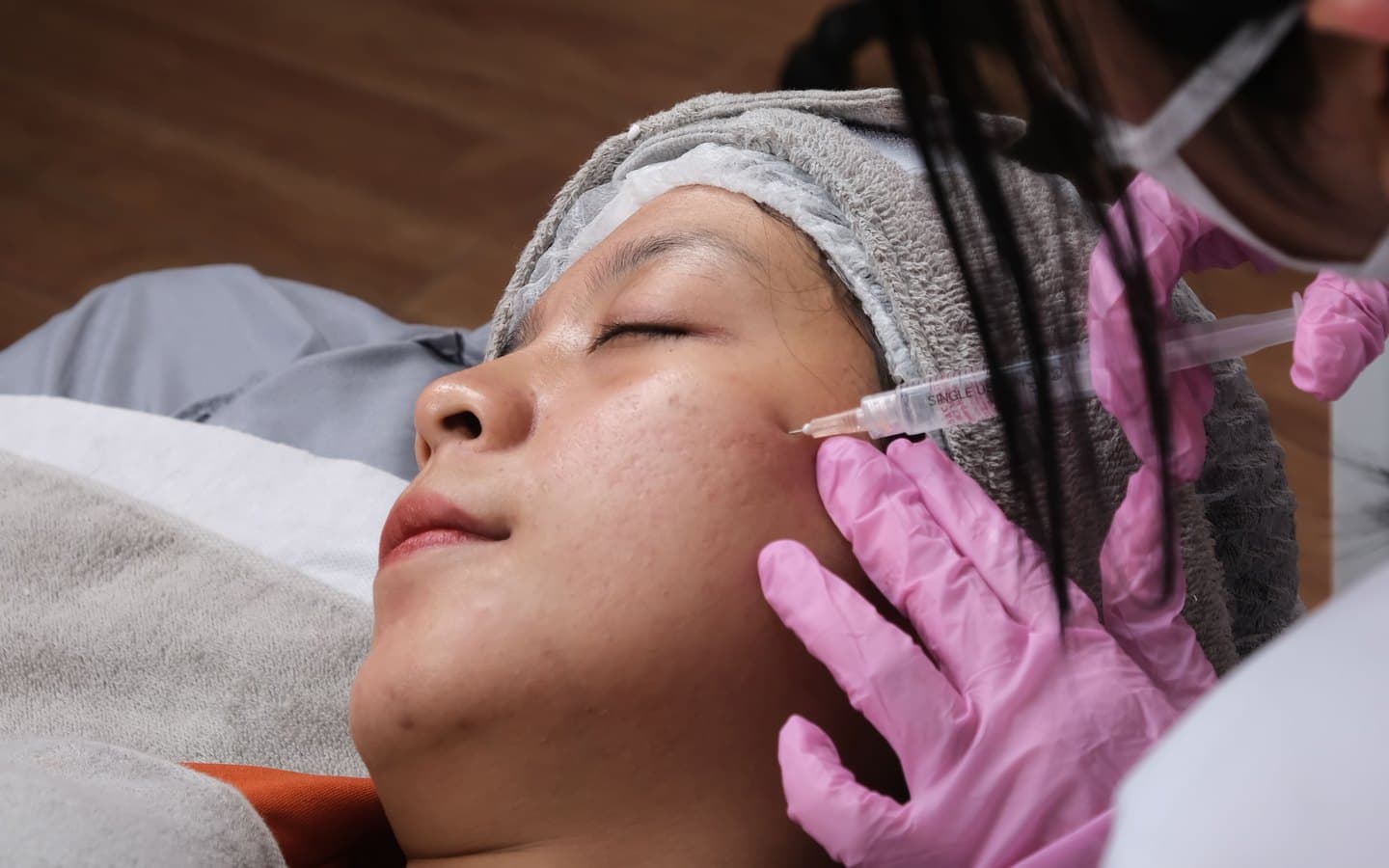
What affects the number of sessions, and the cost
Pricing is discussed at consultation rather than quoted online, so any figure reflects your assessed plan rather than a generic package. What moves it:
- The area treated: a single fold, a jawline, both hands or the décolletage are very different in scope.
- How much support has been lost.
- The quantity your doctor judges appropriate.
- Whether your plan is staged across more than one visit.
Diluted applications over broader areas are often planned as a short course with review.
Ask what a plan might involveOther injectables we use
These address overlapping concerns. Which one suits you is a decision for a doctor who has examined your skin, not a choice to make from a page.
Common questions
Is Radiesse a filler or a collagen stimulator?
Both descriptions are used, which is why it confuses comparison shoppers. The manufacturer describes immediate volume correction from the gel carrier plus stimulation of your own collagen and elastin over time as the calcium hydroxylapatite microspheres are resorbed. That makes it behave differently from a hyaluronic acid filler and differently again from a purely gradual stimulator, and your doctor will explain which behaviour fits your concern at consultation.
What is hyperdilute or HD Radiesse?
It refers to Radiesse thinned with sterile saline so it can be spread more thinly across a broader area rather than used for focal structural support, the manufacturer's labelling covers a diluted preparation for the décolletage. Whether a diluted approach is appropriate for you, and at what dilution, is entirely the treating doctor's decision after in-person assessment. We do not publish dilution or volume guidance.
Can Radiesse be used on the hands and chest, not just the face?
The manufacturer's cleared indications include restoring volume to the back of the hands and, in diluted form, the décolletage, in addition to facial folds and jawline contour. Whether those areas are appropriate for you depends on your skin, your medical history and the assessment. A doctor examines the area in person before advising.
How long does Radiesse last, and can it be reversed?
Duration varies between individuals and is not something we quote as a promise: the calcium hydroxylapatite is bioresorbable and is cleared by the body over time, and your own tissue continues to age. Unlike hyaluronic acid fillers, it has no dissolving agent, so it cannot be reversed on demand, which is why careful assessment beforehand matters. Your doctor will discuss realistic expectations and review timing at consultation.
Read next



Book a free consultation
The consultation is free, takes about 20 to 30 minutes, and there is no obligation to book treatment afterwards. A doctor will examine your skin and tell you whether Radiesse is appropriate, and if it isn’t, what would be.
Ask about thisMedically reviewed by

Dr Chin Wei Horng
Aesthetic Physician
MD, GCFM, OHD, MAC, LCP Certified · MMC 50809
Dr. Chin is a medical doctor with over 10 years experience in clinical practice, dedicated to helping patients look and feel their best through safe, effective, and personalised treatments. He graduated from Crimea State Medical University and gained valuable clinical experience in emergency medicine and psychiatry during his compulsory service, forming a strong foundation in patient care.
View full profile- Reviewed by
- Dr Chin Wei Horng, MMC 50809
- Last reviewed
- 18 Jul 2026
- Next review due
- 18 Jul 2027
This page is general information about aesthetic treatments and is not medical advice. Treatments carry risks that are explained during consultation, and individual results vary. A doctor will assess whether a treatment is suitable for you before it is carried out.