
Lifting & Tightening · Device
Liftera
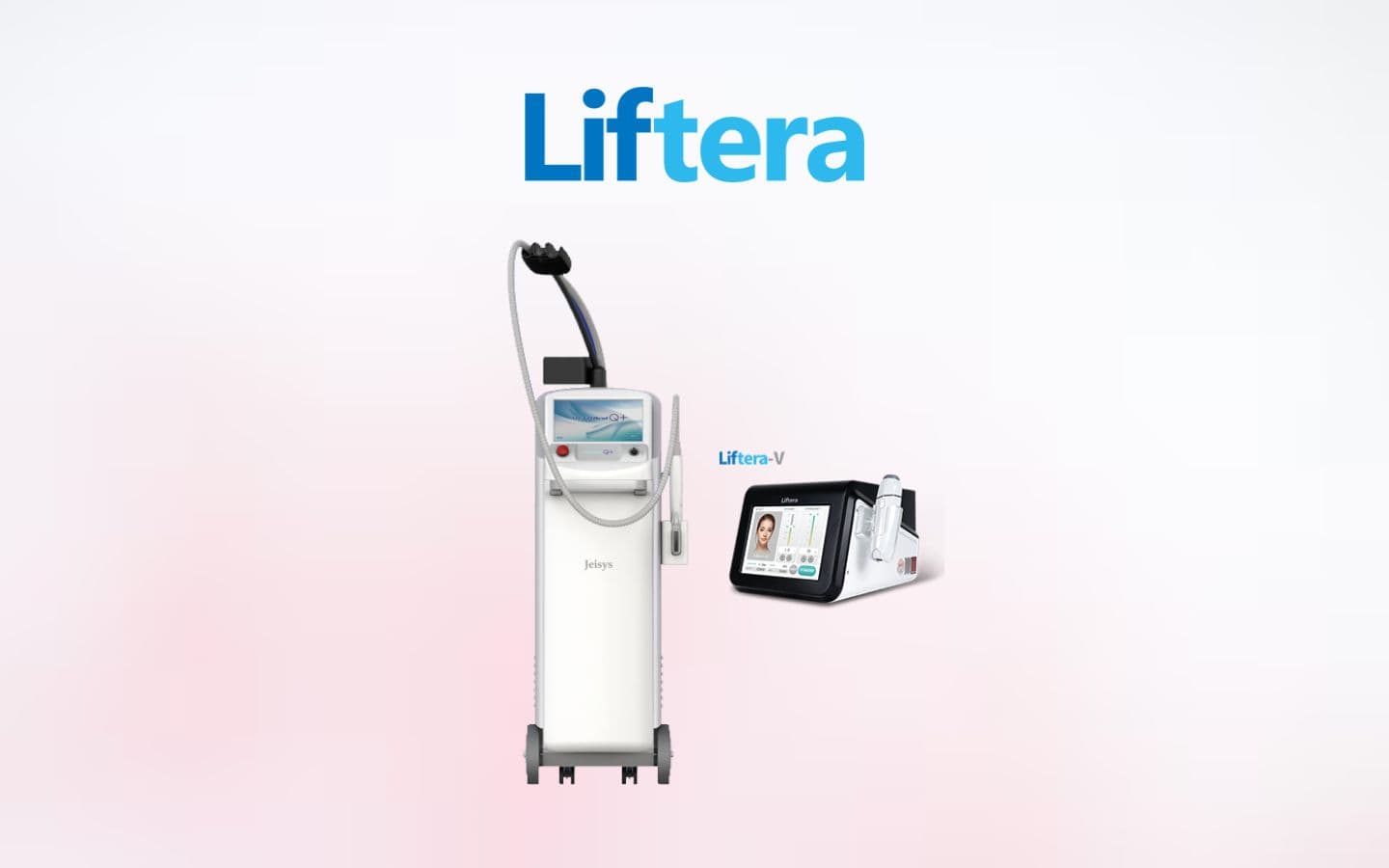
A line-focused ultrasound lifting device from Korean manufacturer Asterasys, used within Kaiteki's HIFU treatment for lifting and tightening concerns.
Free consultation, no obligation.
- Line-focused ultrasound
- Energy
- Asterasys, Korea
- Manufacturer
- HIFU
- Used within
In brief
Liftera, also written Lifthera, is a focused-ultrasound lifting device from Asterasys in Korea, used at Kaiteki within our HIFU treatment. It delivers energy along a line rather than as separate points, and the areas are mapped at consultation rather than treated uniformly.
What is Liftera?
Liftera (also written Lifthera) is a focused-ultrasound lifting device from Asterasys, a Korean medical aesthetic device manufacturer. It belongs to the same broad category as other HIFU devices: ultrasound energy is focused to a point beneath the skin surface so that heating happens in a chosen deeper layer while the surface is largely spared. At Kaiteki it is one of the devices used within the HIFU treatment, and it is often chosen for facial contour work rather than as a whole-face blanket treatment.
How line-focused ultrasound works
Asterasys describes the platform as using what it calls Thermal Diffusion Treatment (TDT™) technology delivered through line-type cartridges. Instead of depositing energy as a series of separate dots, the focus is drawn along a line, and the manufacturer states that this produces larger, more continuous zones of thermal coagulation in the target tissue than dot-based delivery at the same depth. Asterasys also describes irradiation at a faster 10 Hz rate, with the intention of depositing energy at the chosen depth without damaging the epidermis.
Practically, that continuous-line approach is what the manufacturer links to reduced discomfort: the exposure at any one point is brief, and the heat is spread rather than concentrated in single hot spots. Asterasys supplies a pen-type applicator alongside the standard cartridges for smaller and more curved areas such as around the eyes, the nasolabial region and along the jaw. Cartridge choice, depth, energy level and the number of lines are all set by the treating doctor for your anatomy. Any change develops gradually over the following weeks and varies between individuals.
Line-focused, dot-based or imaging-guided: where does Liftera sit?
Where it sits in the category is worth understanding if you are comparing quotes. It is a line-focused HIFU platform, not an imaging-guided system, and it is generally positioned as a comfort-oriented, contour-focused option rather than a deep single-session lift. Whether it is the right device for your particular pattern of laxity is a clinical judgement your doctor makes at an in-person consultation.
Conventional HIFU deposits energy as a row of separate focal dots, whereas Asterasys describes Liftera as drawing the focus along a continuous line. Neither approach is automatically better for every face. They suit different patterns of laxity and different areas.
When is a device like Liftera not the right answer?
Liftera is commonly considered where the concern is contour and firmness rather than surface texture or pigment. It is usually aimed at people with early to moderate laxity. If your laxity is advanced, your doctor may tell you plainly that a non-surgical tightening device is unlikely to be the right answer.
It is not suitable for everyone, and a consultation determines whether it is appropriate for you. Concerns it is typically considered for include:
- Softening definition along the jawline and jowl area
- Mild to moderate laxity in the cheeks and mid-face
- Loose-feeling skin under the chin
- Laxity in smaller, curved areas such as around the eyes and nasolabial region
- Overall skin firmness as part of a maintenance plan
What would rule out Liftera for you?
Focused ultrasound is absorbed by tissue rather than by melanin, so it is generally used across a wide range of skin tones, including deeper Asian skin, without the pigment considerations that apply to some light-based treatments.
It may not be suitable during pregnancy or breastfeeding, over active infection, inflamed acne or open wounds in the treatment area, or where implants, metallic or cardiac devices, or recently placed dermal fillers lie in the intended path. Keloid tendency, certain medications and some medical conditions also need to be considered. Please bring your full medical history and a list of previous aesthetic treatments to consultation.
Why is a Liftera session mapped area by area, and what is recovery like?
A visit begins with a doctor consultation and an assessment of where your laxity actually sits, so that the treatment is mapped rather than applied uniformly. If Liftera is appropriate, the skin is cleansed, the areas are marked and ultrasound coupling gel is applied. Topical numbing may be offered depending on the area. The doctor then delivers passes with the selected cartridges, using the pen-type applicator for smaller or curved regions where a large cartridge does not sit well.
A face and neck session commonly takes in the region of 45 to 75 minutes including preparation, depending on the areas covered. Plans vary: some are structured as a single session with a review a few months later, others as a small number of sessions spaced weeks apart, sometimes combined with other devices. Your doctor will set out what is realistic for you.
Downtime is usually minimal and most people carry on with their day afterwards. Mild redness, slight swelling or tenderness in the treated area can occur and generally settles within a few days, though this varies between individuals.
Gentle skincare and daily sun protection are advised afterwards, and your doctor may ask you to avoid intense heat such as saunas or hot yoga for a short period. Specific aftercare guidance is given for your plan.
What are the risks of Liftera's line-focused ultrasound?
As with any medical procedure, focused-ultrasound treatment with Liftera carries risks, which are explained during consultation. Temporary effects can include redness, swelling, tenderness, small bruises, or transient numbness or tingling; less commonly, welts or temporary nerve-related effects such as localised muscle weakness have been reported with focused-ultrasound treatments generally. Serious effects are uncommon when the treatment is appropriately selected, carefully mapped and performed by a trained doctor.
Concerns this device addresses
Whether it is the right choice for any of these is a decision for a doctor who has examined your skin.


Treatments that use Liftera
Back to all devices and injectables
What affects the number of sessions, and the cost
Pricing is discussed at consultation rather than quoted online, so any figure reflects the plan actually recommended for you. What moves it:
- The areas treated: a targeted jawline plan and a full face-and-neck plan are priced differently.
- The number of lines or passes delivered, rather than time in the chair.
- Whether your plan is a single session with review or a short course.
- Whether it is combined with another device.
Other lifting and tightening devices
These address overlapping concerns. Which one suits you is a decision for a doctor who has examined your skin, not a choice to make from a page.
Common questions
What is Liftera and who makes it?
Liftera, also written Lifthera, is a focused-ultrasound lifting device made by Asterasys, a Korean aesthetic device manufacturer. It delivers ultrasound energy focused along a line at a set depth beneath the skin, using what the manufacturer calls Thermal Diffusion Treatment technology. Your doctor can explain at consultation why this device might be chosen for your face rather than another in the same category.
How does Liftera differ from dot-based HIFU devices?
Conventional HIFU deposits energy as a row of separate focal dots, whereas Asterasys describes Liftera as drawing the focus along a continuous line, which it says creates larger and more continuous heated zones at the same depth and is more comfortable. Neither approach is automatically better for every face. They suit different patterns of laxity and different areas. Your doctor selects the device and settings after assessing your skin.
Can Liftera be used around the eyes and other small areas?
Asterasys supplies a pen-type applicator intended for curved and delicate regions such as the periorbital area, the nasolabial folds and along the jaw, where a full-size cartridge does not make good contact. Whether these areas are treated in your case depends on your anatomy and what you are trying to address. Your doctor decides which areas are appropriate at consultation.
How soon would I notice anything after a session?
Focused-ultrasound treatments work by prompting a gradual tissue response, so any change tends to develop over weeks to a few months rather than immediately, and it varies considerably between individuals. Some people notice a mild firmness early on that is not the final picture. Your doctor will explain a realistic timeline and when a review makes sense.
Read next




Book a free consultation
The consultation is free, takes about 20 to 30 minutes, and there is no obligation to book treatment afterwards. A doctor will examine your skin and tell you whether Liftera is appropriate, and if it isn’t, what would be.
Ask about thisMedically reviewed by

Dr Jessie Lim Jia Min
Founder & CEO, Aesthetic Physician
MD, LCP Board Certified, MAC, AAAM · MMC 64964
Dr Jessie Lim is a LCP certified aesthetic doctor. She obtained her medical degree from University Putra Malaysia with honours. She then went on to pursue her post-graduate certification in Aesthetics in Medical Aesthetic Certification Programme and American Academy of Aesthetic Medicine (AAAM).
View full profile- Reviewed by
- Dr Jessie Lim Jia Min, MMC 64964
- Last reviewed
- 18 Jul 2026
- Next review due
- 18 Jul 2027
This page is general information about aesthetic treatments and is not medical advice. Treatments carry risks that are explained during consultation, and individual results vary. A doctor will assess whether a treatment is suitable for you before it is carried out.